Ever feel your brain itching for a satisfying challenge? Get ready to scratch that itch! Number riddles, especially the kind that ask "what comes next?", are a fantastic way to sharpen your mind and boost your problem-solving skills.
This blog post is your ultimate guide to mastering these numerical puzzles. We'll dive into the logic behind "what comes next" number riddles, explore different types of sequences, and provide you with plenty of examples to test your wits.
Prepare to unlock the secrets hidden within number patterns and become a true riddle master! Let's get started!
Best What Comes Next Number Riddles Brain Teasers for All Ages
I dance in Fibonacci's shadow, whispering growth. I am 2, 3, 5, 8, 13... who follows?
21
I stand alone, then double, double again. Starting at 1, who am I after 8?
16
From zero, I leap, then crawl back slowly. 0, 1, -1, 2, -2... who waits for you?
3
Squares of the primes assemble, 4, 9, 25, 49... who next takes the stage?
121
I'm the sum of my parts, reaching backwards two places. I start with 1, 3, 4, 7... who am I after that?
11
Subtracting each time grows smaller, 100, 91, 82, 73... what chilling number awaits?
64
I jump by odds, starting at two. 2, 5, 10, 17... who joins the scene with a prime sum?
26
I halve, then halve again, starting big. 64, 32, 16, 8... what's my final shrink?
4
Triangular numbers arise, 1, 3, 6, 10... who completes the next perfect form?
15
Cubes ascend, a steady rise. 1, 8, 27, 64... what powerful number follows suit?
125
Alternating plus and minus, a steady climb. 1, 3, 1, 4, 1... what fraction appears?
5
Primes increase, but not in line. 2, 3, 5, 7... what comes next, still sublime?
11
I mirror myself, with a growing divide. 1, 11, 21, 1211... who comes after, inside?
111221
The power of two, minus one, takes the stage. 1, 3, 7, 15... who feels like turning a new page?
31
I am the product of consecutive integers, starting from one. 1, 2, 6, 24... what monumental quantity is this?
120
What Comes Next Number Riddles: Unveiling the Patterns
Ever wondered what sneaky secrets lie hidden within number sequences? "What Comes Next Number Riddles" invites you to become a pattern detective! Sharpen your mind, embrace the logic, and unlock the numerical codes. Discover fascinating progressions and predict the missing piece of the puzzle. It's all about unveiling the beauty...
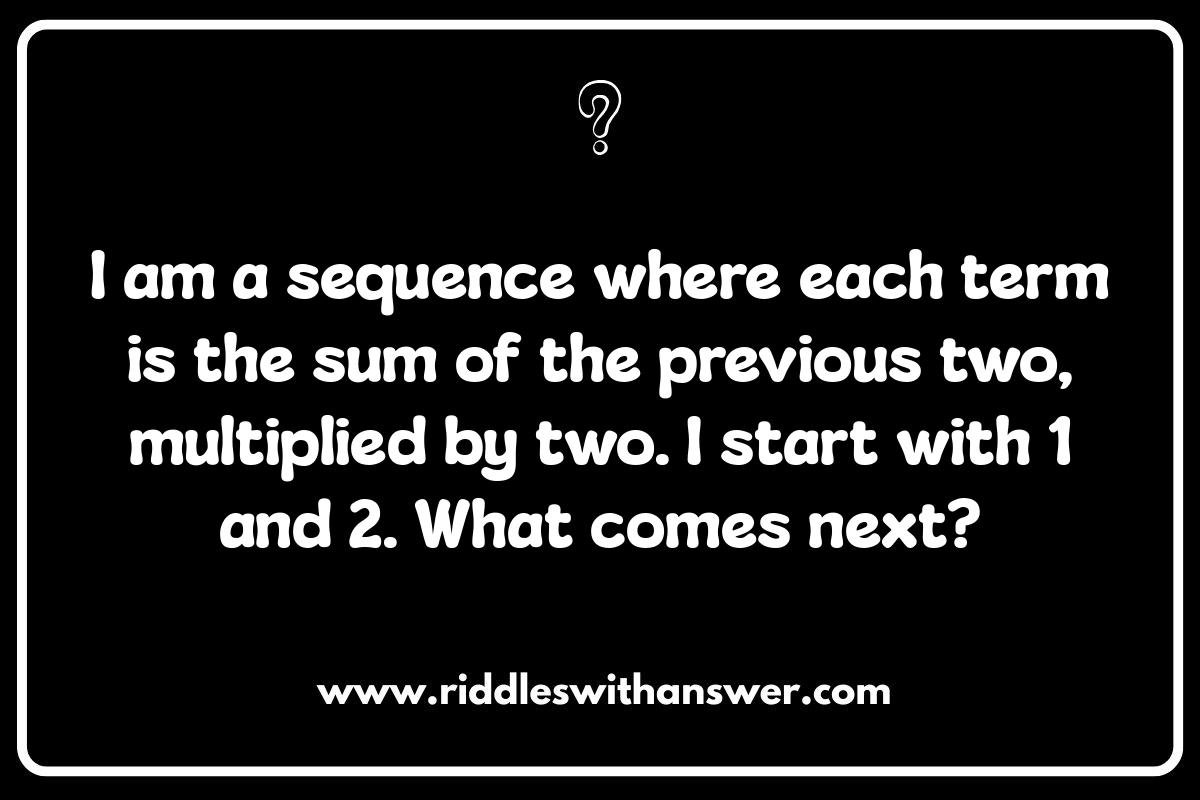
I am a sequence where each term is the sum of the previous two, multiplied by two. I start with 1 and 2. What comes next?
10
I'm the number of faces on a dodecahedron, minus the number of sides on a decagon. What am I, geometrically subtracted?
10
If you multiply me by 3, add 5, and then divide by 2, you get 11. What number am I?
7
I am a number less than 50. I am divisible by 8, but not by 5. I am 4 more than a perfect square. What am I?
24
What follows 1, 4, 27, 256?
3125 (The sequence is 1^1, 2^2, 3^3, 4^4, 5^5)
I am a two-digit number. My digits are both prime. I am greater than 20, but less than 40. I am divisible by 3. What number am I?
33
I'm the number of faces on a triangular prism, plus the number of sides on a hexagon, minus the number of vertices on a square. What am I, geometrically balanced?
11
I am a three-digit number. My hundreds digit is one less than my tens digit, and my ones digit is one less than my hundreds digit. The sum of my digits is 6. What number am I?
321
If you multiply me by 4 and add 10, you get the same result as multiplying me by 6 and subtracting 2. What number am I?
6
I am a number. I am the number you get when you add all the numbers on a clock face. What am I?
78
My sequence starts with 4. Each subsequent number is found by subtracting 1 and then multiplying by 2. What is my third number?
2
I am a prime less than 20, and the sum of my digits is 8. What number am I?
17
I am a number less than 100. I am a multiple of 13, and I'm the product of two consecutive prime numbers. What am I?
26
My terms are the number of letters in their ordinal form. Who am I, starting with 1?
3 (One, three, five...)
I am a three-digit number. My digits are consecutive and descending. I am divisible by 3 and 5. What number am I?
960
What Comes Next Number Riddles: Logic and Deduction Skills
Unravel the secrets hidden within number sequences! "What Comes Next" number riddles challenge you to flex your logic and deduction skills. Spot the patterns, identify the rules, and predict the missing number. It's a fun way to sharpen your mind and boost your problem-solving abilities, one number at a time.
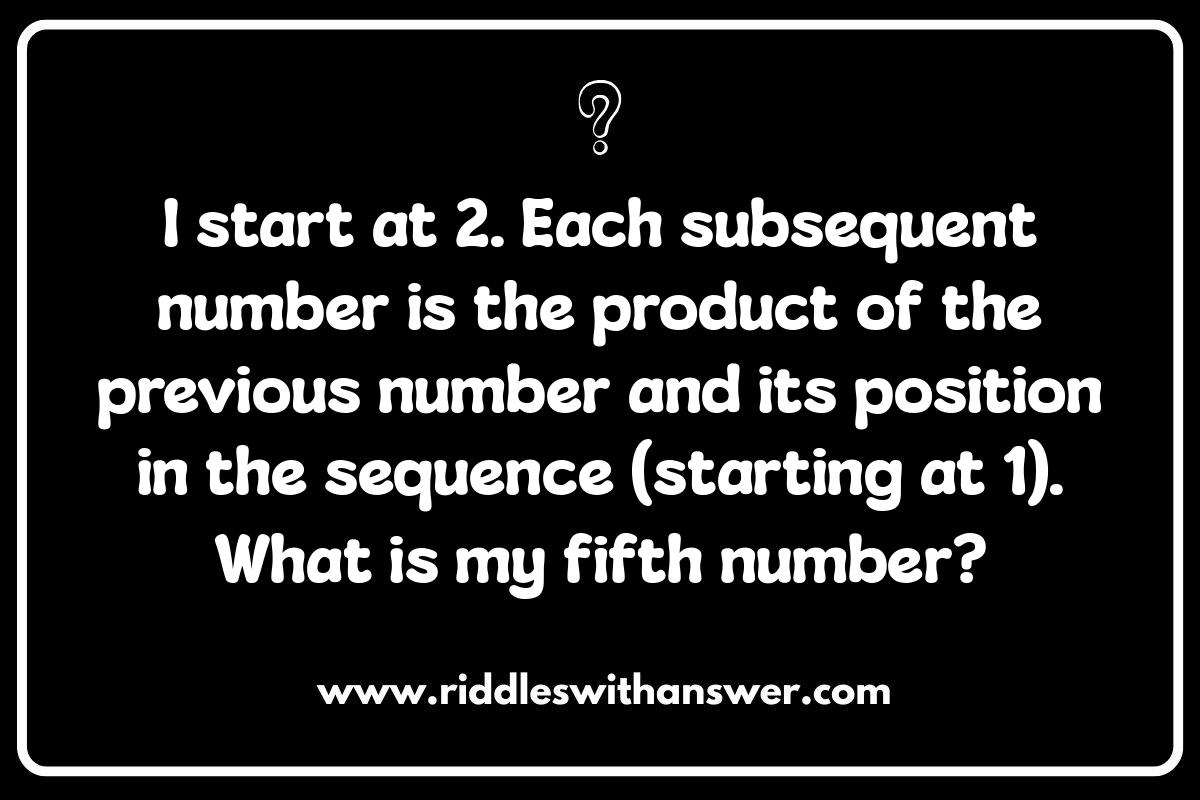
I start at 2. Each subsequent number is the product of the previous number and its position in the sequence (starting at 1). What is my fifth number?
288
My sequence is the sum of the previous two terms, but I start at 0 and 3. What is my eighth term?
55
I begin at 1. Each following number is calculated by subtracting the square root of the previous number from 10. What is my second number, rounded to the nearest tenth?
9.0
My progression is formed by squaring consecutive even numbers, starting from 2. What follows 16?
36
I begin at 1. Each subsequent term is the number of distinct prime factors of the previous term. What is the fifth number in my sequence?
0
My sequence consists of adding the previous two numbers, and then subtracting 1. What number am I, if my first two numbers are 1 and 2?
7
I am the sequence of cubed numbers, alternating between positive and negative. What is my fourth term?
-64
I am a series which begins with 0, 1. Every term after that is the sum of the previous term and twice the term before that. What is my 5th term?
11
I begin at 1. Each following number is the previous one squared, minus the number of sides on a square. What is my third term?
-7
I am formed by the sum of consecutive factorials, starting with 0!. What number is next in line?
34
I am the sequence of powers of 3, but only the odd powers. What is my third number?
243
I am a sequence of perfect squares that are also multiples of 4. What follows 36?
64
I jump by odds, starting at three, but skip the number seven. What's my selective scene?
11
My sequence is created by multiplying the previous number by 2, then adding the previous number's position in the sequence (starting the position count at 1). If I start at 1, what is my third number?
7
I'm the sequence of digits of the square root of 2. What comes after 4?
1
What Comes Next Number Riddles: Common Sequences Explained
Ever stumble upon a number sequence and feel utterly stumped? "What Comes Next Number Riddles: Common Sequences Explained" demystifies those brain-teasers. It breaks down the usual suspects – arithmetic, geometric, Fibonacci, and more – showing you the patterns and logic behind them. Get ready to confidently crack those numerical codes!
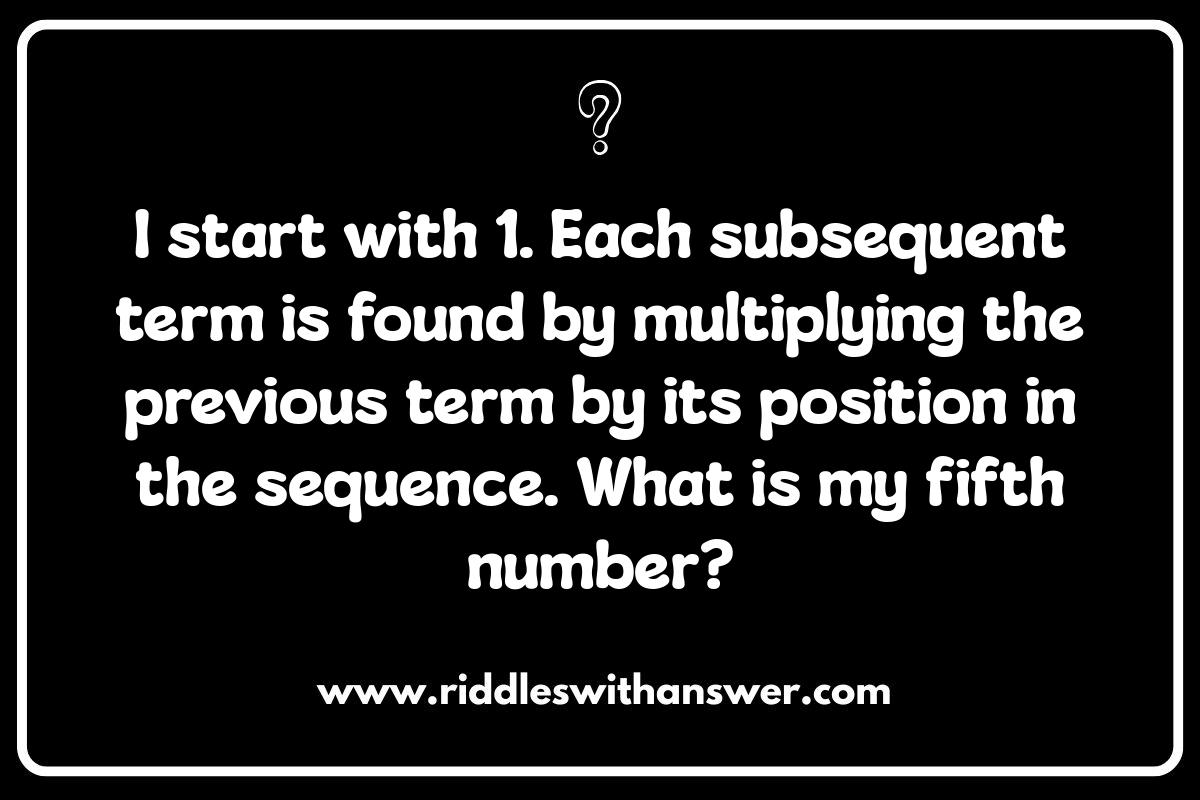
I start with 1. Each subsequent term is found by multiplying the previous term by its position in the sequence. What is my fifth number?
120
My terms are the number of letters when spelling out the previous term, plus one. I start with 0. What comes after 4?
12
I am a sequence of prime numbers, each separated by three composite numbers. I start at 5. What is my second number?
13
We grow by adding consecutive multiples of 2, starting with 2. We begin with 1. What is the fourth number in my sequence?
13
I’m formed by subtracting consecutive odd numbers, starting from 1. What comes after 0?
-3
I start with 1. Each number is found by adding 4 to the previous number. What is the seventh number in my sequence?
25
I am formed by doubling the previous number and subtracting one. What is the result of starting at 2 and doing this twice?
5
My sequence grows by adding consecutive numbers to the previous term, starting with 1. If my first term is 0, what is my 5th term?
10
I follow a pattern of multiplying the previous number by 2, then subtracting 1. If I start with 3, what's my 4th term?
23
I am the sequence of squares, alternating between positive and negative. What is my fourth number?
-16
I am the sequence of the sums of consecutive odd numbers, starting from 1. What comes after 9?
16
In the sequence of powers of 2, what comes after 64?
128
I am formed by subtracting consecutive whole numbers from one another, starting at 10. 10, 9, 7… who am I?
4
I follow a pattern of adding consecutive prime numbers, starting with 2. If I start with 5, what is my fourth number?
16
I grow by adding consecutive even numbers, starting from 2. I start at 3. What is my fifth number?
23
What Comes Next Number Riddles: Difficulty Levels and Variations
"What Comes Next" number riddles offer brain-teasing fun for everyone! Difficulty ranges from simple arithmetic sequences perfect for beginners, to complex patterns involving prime numbers or Fibonacci sequences for advanced solvers. Variations include geometric progressions, alternating series, and even riddles disguised with real-world scenarios. Explore the levels and discover your...
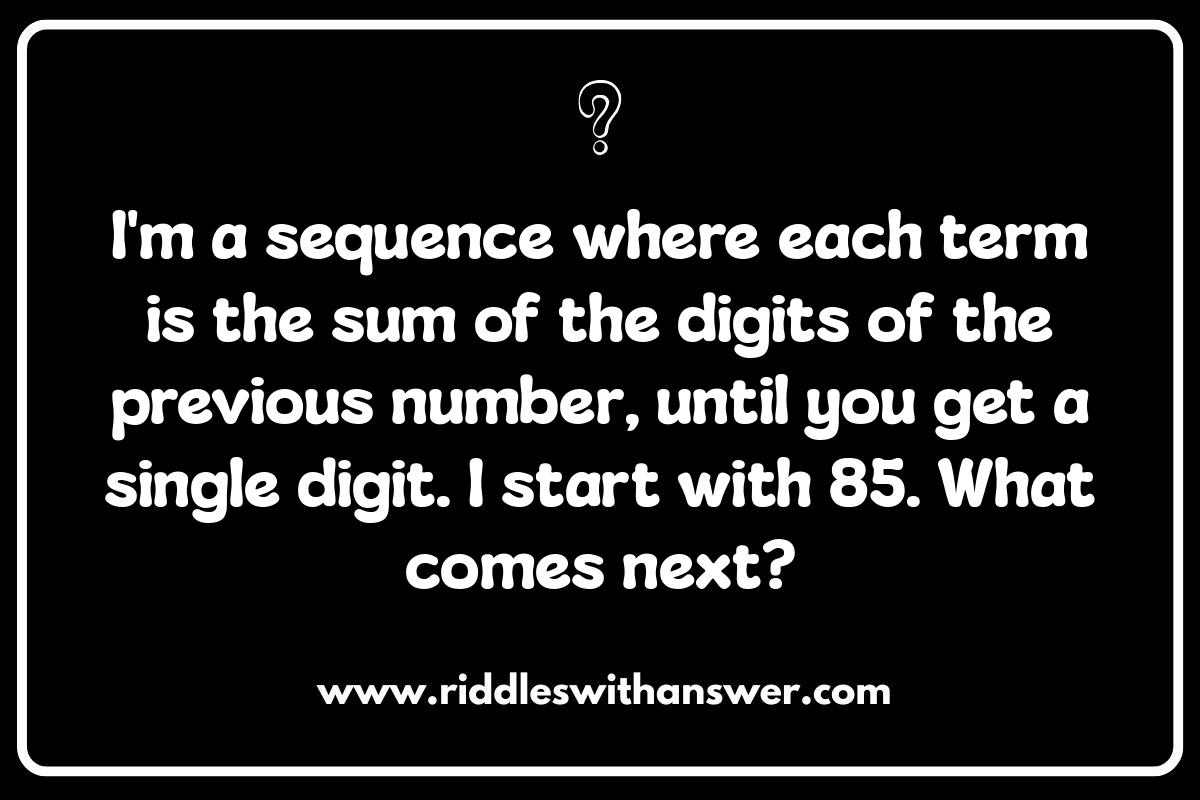
I'm a sequence where each term is the sum of the digits of the previous number, until you get a single digit. I start with 85. What comes next?
4
Our pattern builds by adding consecutive multiples of 3, starting with 3. Our first number is 2. What is the fourth number in our pattern?
20
I am generated by subtracting consecutive even numbers from 100. What is my fourth number?
88
I am the Look-and-Say sequence. What comes after 312211?
13112221
I am a sequence where each number is the product of the previous number's digits. If I start at 341, what is my third number?
12
I increase by adding consecutive prime numbers, starting with 2. I begin at 4. What is my fifth number?
21
I am the Fibonacci sequence, but I skip a number between every two Fibonacci numbers. If I start with 1, 1, 3, 5, what number follows?
13
I am formed by taking the square root of the previous term and adding 1. If I start at 9, what is my third number (rounded to the nearest whole number)?
3
I am a sequence. 1, 2, 3, 5, 8. What is the next number in my sequence?
13
I am a series made of perfect cubes. What is my seventh number?
343
I am a sequence that begins with 1. Each subsequent number is found by adding the previous number to its square. What is my third number?
17
I am an alternating sequence, with each number being the product of the previous number, 2, and 3. I start with 1. What is my fourth number?
18
My terms are the number of letters of the alphabet, plus the number of points on a star of David. What am I?
32
I am a sequence. My first term is 1, and to calculate the next terms, you multiply by 3 and add 1. What is my third number?
13
Every number is twice the one before, but only when that one is a perfect square. I start with 1. What is my third number?
16
What Comes Next Number Riddles: Strategies for Solving Them
Unraveling number riddles can feel like cracking a code! "What Comes Next" challenges your pattern recognition. Look for addition, subtraction, multiplication, or division sequences. Sometimes, it's a combination! Spotting the underlying rule is key. Practice sharpens your intuition, transforming puzzling sequences into satisfying solutions.
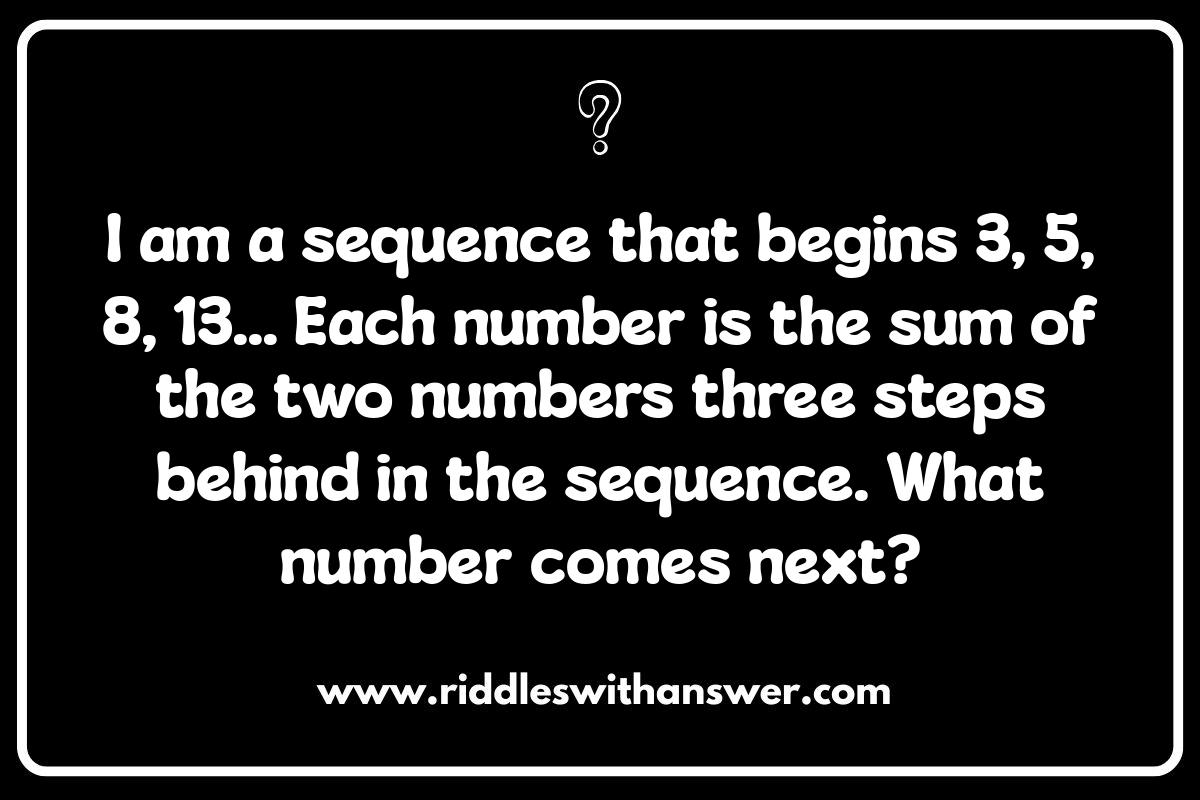
I am a sequence that begins 3, 5, 8, 13... Each number is the sum of the two numbers three steps behind in the sequence. What number comes next?
21
I start at 100. Each subsequent number is found by subtracting consecutive multiples of 5. What is my fourth number?
70
I am formed by adding consecutive numbers, beginning with 1. After each multiple of 5, I reset to 1. What comes after 15?
1
My sequence is 1, 3, 7, 13... Each difference between my terms increases by 2. What is my fifth number?
21
Begin with 1, and for each subsequent term, multiply the previous number by 2 and add 3. What is my third number?
13
I'm a sequence of perfect cubes, skipping every other cube. 1, 27, 125... what powerful number follows?
343
Start with 40. Each subsequent number is half the previous number, rounded *up* to the nearest integer. What is my third number?
10
My pattern is 1, 8, 27... Every number is a perfect cube. What is my next number?
64
I add 1, then subtract 2, then add 3, then subtract 4... I start at 5. What comes after 3?
7
I'm the squares of consecutive odd numbers, but I skip every other square. I begin with 1, then 25... what number follows?
81
I start at 1, and grow exponentially. I am the product of the previous term and a prime number that has not been used in the sequence previously. What is my third number?
30
I begin with 1, and each subsequent term is the number of letters in the spelling of the previous term. What is my fifth number?
5
My sequence is made of prime numbers. What number comes next: 2, 3, 5, 7, 11?
13
I grow by adding consecutive multiples of four, starting with 4. I begin with 2. What is my fourth number?
38
I start with 1, and each subsequent number is the result of multiplying the previous number by itself, then adding 1. What is my third number?
26
What Comes Next Number Riddles: Real-World Applications
Beyond simple puzzles, "what comes next" number riddles mirror real-world pattern recognition. Predicting stock prices, forecasting weather, or even understanding biological sequences relies on identifying underlying numerical trends. Sharpening your riddle-solving skills enhances your ability to analyze data and make informed decisions in various fields.
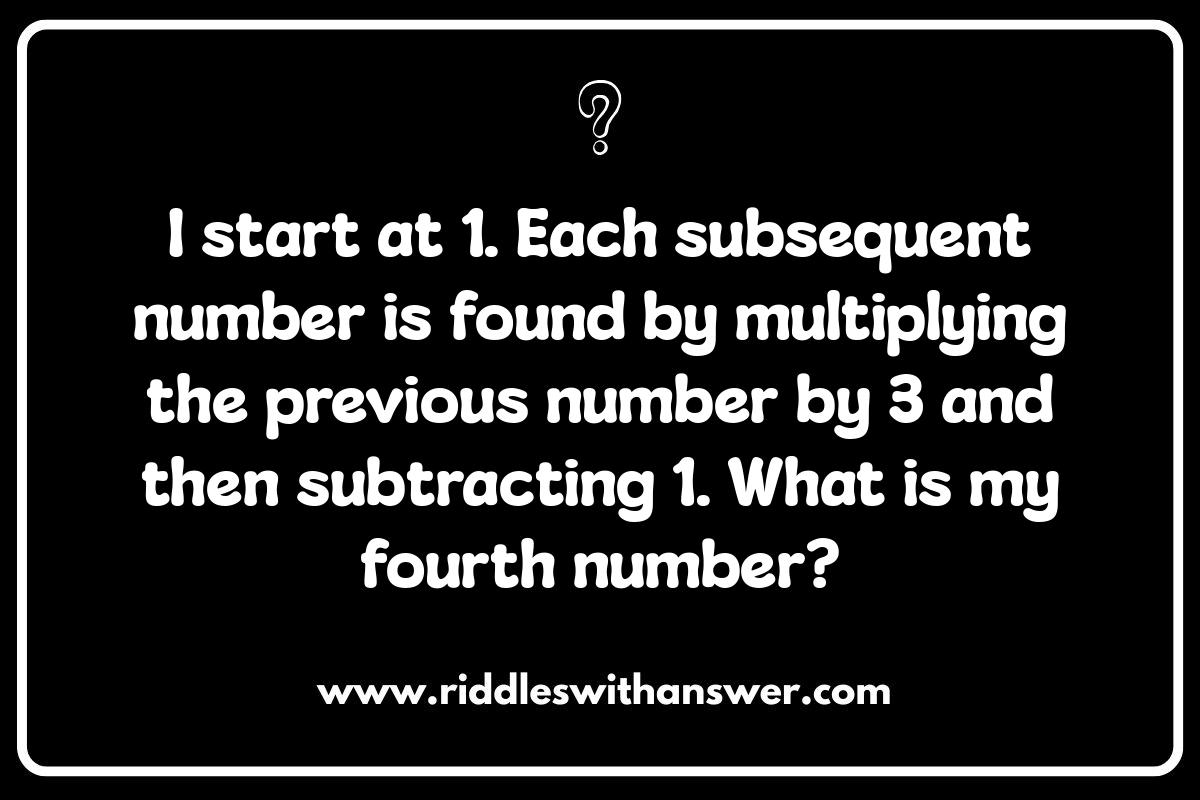
I start at 1. Each subsequent number is found by multiplying the previous number by 3 and then subtracting 1. What is my fourth number?
47
My sequence grows by adding consecutive odd numbers, starting with 5. If my first number is 2, what is my third number?
12
I am a number. If you multiply me by 3, add 8, and then divide by 2, you get 10. What number am I?
4
I am a sequence where each term is the product of all the digits of the previous term. I begin with 678. What is my third number?
336
I am a series. My first term is 1. My second term is 3. Each subsequent term is the sum of all preceding terms. What is my fourth number?
14
I follow the pattern of adding consecutive even numbers, starting with 2. If I start with 0, what is my fifth number?
20
I am a number. If you divide 32 by me, you get the same result as subtracting me from 12. What am I?
4
I am a sequence where each number is the cube of the previous number. If I start with 2, what is my second number?
8
I am a number. If you multiply me by 5, and then add 10, you get the same result as multiplying me by 4 and adding 15. What number am I?
5
The number of sides on a hexagon, plus the number of wheels on a bicycle, divided by 2. What am I?
6
My differences increase by 2. Starting from 1, who am I after 3?
7
I am the number of faces on a cube, plus the number of corners on a cube, minus the number of sides on a square. What am I?
12
If I triple, then add 1, and repeat, what chain follows 2?
25
I start at 1. Each subsequent number is the previous one multiplied by itself and then added to itself. What is my second number?
2
I am a number. If you divide 24 by me, you get the same result as subtracting me from 10. What am I?
4
What Comes Next Number Riddles: Creating Your Own Challenges
Ready to level up your number riddle game? "What Comes Next Number Riddles: Creating Your Own Challenges" empowers you to design brain-teasing sequences. Uncover the secrets behind crafting patterns, from simple arithmetic to complex algorithms. It's all about sparking creativity and challenging others (or yourself!) with custom numerical puzzles.
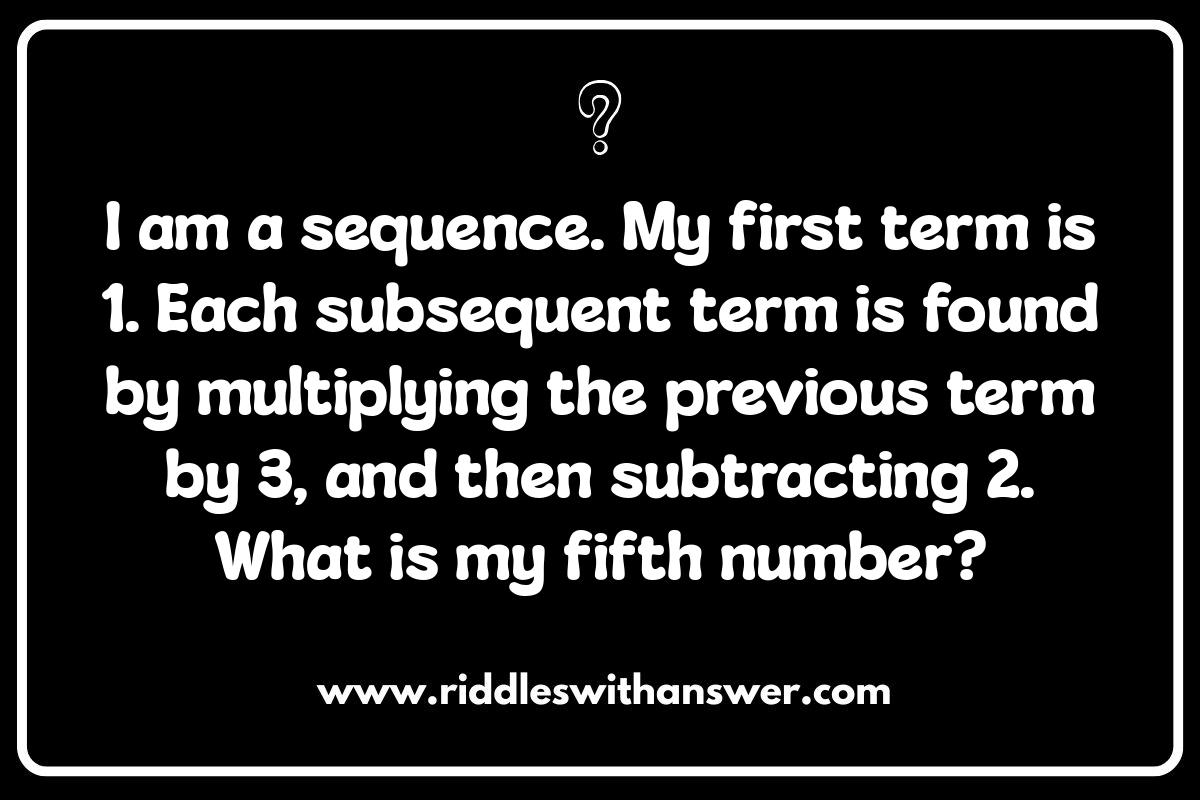
I am a sequence. My first term is 1. Each subsequent term is found by multiplying the previous term by 3, and then subtracting 2. What is my fifth number?
49
My sequence begins with 0, 1. Every term after that is the sum of the three terms before that. What is my sixth number?
11
I am formed by squaring consecutive odd numbers, starting from 1. What is the square root of my fifth number?
9
I count by sevens, but only after skipping the first prime number. What am I, with a selective start?
28
I am a sequence of numbers. The first three terms are 1, 1, 3. Every term after that is the product of the two numbers three steps behind in the sequence. What is my fifth number?
3
I subtract consecutive whole numbers, but then restart at 1. Starting at 25, what follows 20?
14
I start with the number of sides on a square. Each subsequent number is the previous number squared, then add the number of points on a triangle. What is my second number?
19
My numbers are built by adding consecutive primes to the previous number. I start with 2. What is my fourth number?
15
I am the sequence of natural numbers, but with the first three prime numbers missing. What number comes after 6?
8
I advance by odds, and then by evens, alternating each time. I commence at 3. What's my fourth term?
12
I am a series of powers of 5, but only the odd powers. What is my second number?
125
I am a sequence where each term is the previous term multiplied by its position in the sequence. If I start at 3, what is my third number?
18
I start with 0, and each subsequent number is the square root of the previous number, plus 2, rounded down to the nearest integer. What is my fourth number, rounded to the nearest whole number?
2
I am formed by adding consecutive factorials, starting with 0!. What number is next in line, if I am less than 10?
5
I am a sequence where each term is the sum of all positive integers up to the term number. What is my sixth number?
21